


.png)
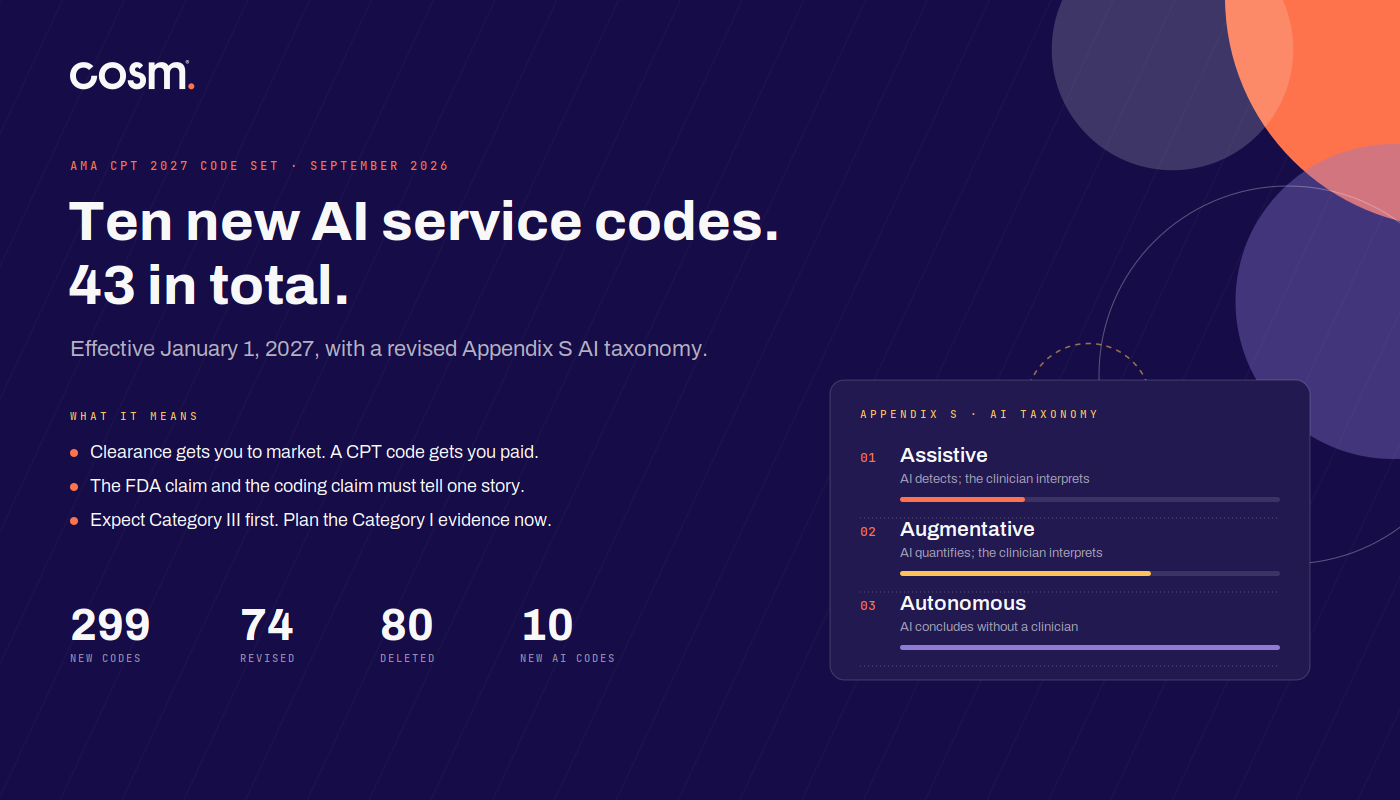


On September 9, 2026, the American Medical Association released the CPT 2027 code set. It carries 453 editorial changes: 299 new codes, 74 revisions, and 80 deletions, all effective January 1, 2027. Buried in the headline numbers is the part that matters for anyone building an AI-enabled medical device: ten of the new codes describe AI-related services, bringing the total number of AI-related CPT codes to 43, and the CPT Editorial Panel has again revised its Taxonomy for Artificial Intelligence in Medical Services and Procedures. Below is what the release says and what it means if you are developing one of these products.
Why a coding release belongs on a regulatory team's radar
CPT codes are the five-digit language of medical billing. Federal law requires providers, payers, and physicians to use them in electronic transactions, and they underpin quality measurement, value-based care contracts, and health data interoperability. For a device company the practical point is simpler: an FDA clearance establishes that a product can be marketed, and a CPT code establishes that someone can be paid for using it. Products that have the first but not the second tend to sit in pilot purgatory, no matter how good the clinical data is.
This is why the AI-related count matters. Ten new codes in a single annual cycle is not a large number against a code set of more than 11,000, but it is a signal that the Editorial Panel is building a steady pathway for algorithm-driven services rather than treating them as one-off exceptions.
The AI taxonomy: assistive, augmentative, autonomous
The framework at the center of every AI-related CPT code is Appendix S, the Taxonomy for Artificial Intelligence in Medical Services and Procedures. It was introduced in 2022 and has been revised for 2027. It classifies the work an algorithm performs into three tiers:
Assistive
The machine detects clinically relevant data without analyzing or generating conclusions. A physician or other qualified health care professional does the interpretation. Think of a tool that flags a region of an image for a radiologist's attention.
Augmentative
The machine analyzes or quantifies data in a clinically meaningful way, but its output still requires interpretation by a clinician. Most of the recent Category III AI codes sit here: automated ECG measurements (0902T), echocardiogram measurements (0932T), quantitative chest imaging (0877T to 0880T), and image-guided prostate biopsy analysis (0898T) were all added as augmentative services in 2025.
Autonomous
The machine performs the analysis and reaches a clinical conclusion without a physician at the point of service. The best-known example is 92229, the Category I code for autonomous retinal imaging to detect diabetic retinopathy, which was the first autonomous AI service to receive a permanent code.
The tier is not a label of convenience. It determines how the code descriptor is written, what physician work (if any) is credited, and therefore how the service is valued. The AMA states that the 2027 taxonomy update is intended to help stakeholders select appropriate terminology for code descriptors as clinical AI evolves. One critique worth knowing, raised by coding-policy commentators, is that the taxonomy classifies types of AI service without ever defining what counts as AI in the first place. Expect that ambiguity to surface in your own code-change discussions.
What else changed in CPT 2027
The AI codes travel alongside a broad set of clinical updates. The maternity care section has been restructured, replacing the decades-old global obstetric bundle with a framework that reflects team-based care. There are three new codes for left ventricular assist device procedures, nine for diaphragmatic hernia repair, six for unattended sleep studies, updated prostate biopsy codes, a time-based structure for biofeedback, and a new head and neck magnetic resonance angiography table.
Two developments outside the code set itself deserve attention. First, coding-policy observers reported earlier this year that the AMA has introduced new documentation and review requirements in the code-change application process specifically for software-dependent and AI services, alongside the revised Appendix S. Second, the AMA has tightened Proprietary Laboratory Analyses (PLA) eligibility to exclude algorithm-only analyses of existing results that lack an accompanying biomarker analysis, which closes a route some AI pathology developers had been exploring.
The coding standard itself is under pressure
The CPT release landed in an unusual policy environment. The AMA faces litigation over its copyright in the code set, with PatientRightsAdvocate.org seeking to make the codes publicly available. Separately, the Centers for Medicare and Medicaid Services is accepting public comments through September 14, 2026 on potential alternatives to the current national coding standard. AMA President Willie Underwood III framed the release as evidence that "a trusted, physician-led coding system is essential." Whatever the outcome, developers should plan on the CPT framework governing reimbursement for the foreseeable future while watching the CMS process closely.
What this means for AI/ML device developers
Treat reimbursement as part of regulatory strategy, not a follow-on. The tier you claim in your FDA indications for use (a triage tool, a quantification tool, an autonomous diagnostic) maps directly onto the assistive, augmentative, or autonomous tier in Appendix S. The clinical claim, the validation study design, and the eventual code descriptor should be built from one consistent story. A submission that positions the device as clinician-supervised and a coding application that positions it as autonomous will fail on one side or the other.
Decide your autonomy tier deliberately. Autonomous claims carry the heaviest FDA evidence burden and the most novel coding path, but they also create the clearest case for a distinct service with its own value. Augmentative claims are easier to clear and easier to code, but the code may bundle into an existing physician service and add little incremental payment. Neither answer is wrong; the mistake is arriving at it by accident.
Expect Category III first. Most new AI services enter as temporary Category III codes used to track utilization. Conversion to a Category I code requires evidence of widespread use, FDA approval or clearance where applicable, and published clinical efficacy data. Design your post-market evidence plan so that the data you collect for FDA post-market obligations also supports a Category I application later.
Budget for the code-change process. The application to the CPT Editorial Panel is its own regulatory-style project, with a public comment period, a panel meeting, and now expanded requirements for software-dependent services. Engage early through the AMA's interested-party process, identify which existing codes your service overlaps, and line up the clinical specialty societies that will need to support the application.
Check the PLA and lab boundaries if you are an algorithm-only diagnostic. If your product interprets existing test results without generating a new biomarker measurement, the PLA path is closed. Plan for a Category III or Category I route instead.
Keep FDA and coding terminology aligned. As the taxonomy evolves, review the language in your labeling, your 510(k) or De Novo summary, and your code-change application together. Terms like "detect," "quantify," and "diagnose" carry weight in both systems.
The bigger picture
Regulators and payers are converging on the same question: how much of the clinical task does the algorithm actually perform, and what evidence supports that? FDA answers it through the intended use and the validation study. The AMA answers it through Appendix S and the code descriptor. CMS answers it through coverage and payment. A developer who can give the same answer to all three, backed by the same evidence, is in a much stronger position than one who optimizes each in isolation. For the FDA side of that alignment, see our overview of the regulations for AI/ML-enabled medical devices in the US and EU and our playbook on the AI lifecycle management model.
How Cosm Can Help
Cosm works with AI/ML and SaMD companies to build regulatory strategies that hold up beyond clearance. We help teams define intended use and autonomy claims that are supportable at FDA and coherent with the reimbursement path, design validation studies that serve both purposes, and prepare 510(k), De Novo, and Pre-Submission packages that say exactly what the device does and no more. If you are planning an AI-enabled device and want the regulatory and coding story to line up from the start, get in touch or visit cosmhq.com.
Source: New AMA CPT codes reflect medical innovation and AI-related services (Healthcare Finance News, September 10, 2026) and the AMA CPT 2027 release.
Disclaimer - https://www.cosmhq.com/disclaimer
