


.png)
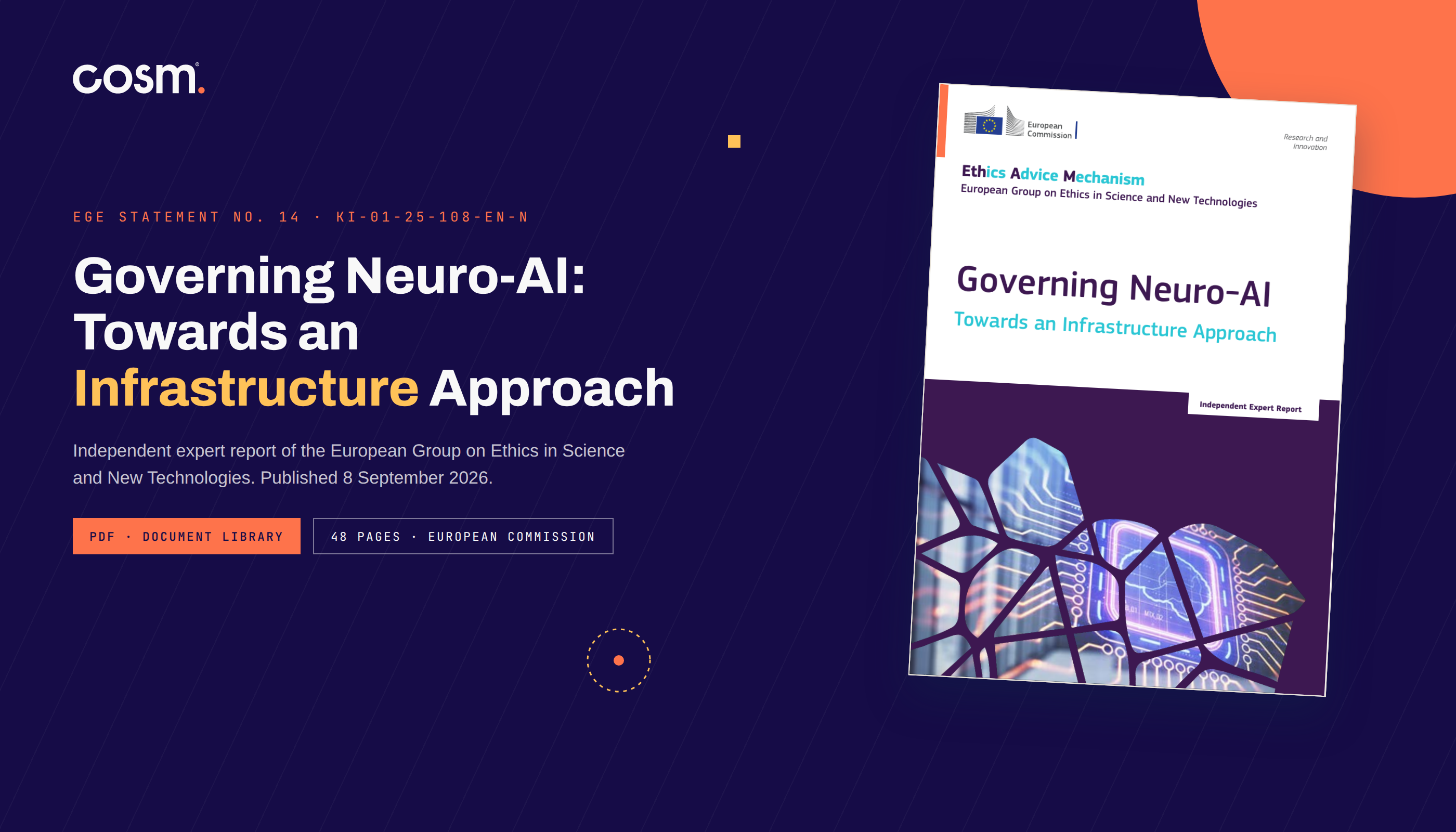


On 8 September 2026 the European Group on Ethics in Science and New Technologies (EGE), the independent advisory body inside the European Commission's Ethics Advice Mechanism, published Governing Neuro-AI: Towards an Infrastructure Approach (Statement No. 14). Most neurotech policy work to date, from the EDPS TechDispatch on neurodata to the OECD and UNESCO recommendations, has focused on individual devices, neural privacy, and consent. This Statement deliberately moves the lens. Its subject is the infrastructure behind the devices: the data pipelines, cloud services, Brain Foundation Models, and business practices through which neurodata are collected, aggregated, and reused across contexts. The EGE is advisory, so nothing here is binding. But the Statement calls on the Commission to run a fitness check of the GDPR, AI Act, MDR, product safety, and consumer protection law as applied to neuro-AI, and it takes explicit positions on wellness neurodata and the MDR intended-use test that device developers will want to understand. Below is what the Statement says and what it means if you are building EEG, BCI, neuromodulation, or any AI that infers cognitive or emotional state.
The core idea: govern the neurostack, not the device
The EGE's central claim is that neuro-AI infrastructures pose a different governance problem from the one addressed by device regulation and data protection as they stand. A conventional neurotechnology device was built for a bounded purpose (a clinical EEG, a deep brain stimulator, an assistive BCI) inside a research or clinical setting with institutional oversight. Today the same signals are increasingly nodes in a wider data, model, and platform ecosystem. Neurodata collected for one service become longitudinal training data, and training data become reusable models that support inferences about other people in other contexts.
The Statement gives this ecosystem a name, the neurostack: a coordinated ensemble of devices, data pipelines, foundation models, cloud services, interfaces, business practices, standards, and oversight mechanisms through which neurodata are collected, processed, reused, and operationalised. It separates two layers within it. The data-and-pipeline layer (neurodata infrastructures) and the model layer (Brain Foundation Models and multimodal Human Foundation Models). The governance argument is that the combination of four features, rather than any single one, warrants distinct attention: collection of neurophysiological data, increasingly powerful inference about cognitive and emotional states, adaptive interaction with the user, and the reuse of those capabilities across contexts through shared models.
Two framings are explicitly rejected. The first reduces the problem to individual privacy and consent. The EGE keeps individual rights in place but argues they cannot capture harms that arise from aggregation and reuse, where neurodata from one group train models that classify other people who never contributed data. The second treats consumer neurotech as a self-contained consumer-protection niche. A sleep headband or a productivity wearable may look benign on its own while functioning as a sensor, cloud-processing node, and model-training pipeline for a much larger infrastructure.
What the Statement covers
From episodic measurement to persistent inference
Section 2 traces the shift from one-off, context-specific measurement to continuous inference. Brain Foundation Models are the headline example: models pretrained on large, heterogeneous, often unlabelled neuroimaging datasets (EEG, MEG, fMRI, MRI, PET) that learn transferable representations adaptable to many downstream tasks. The Statement is candid that BFMs are early stage and face real obstacles (limited data volumes, inter-subject variability, weak standardisation, uncertain scaling laws), but argues this is exactly why the moment matters. Unlike large language models, where many policymakers concluded the governance window was missed, BFMs can still be shaped.
The Statement then looks past BFMs to four adjacent developments: adaptive closed-loop neurotechnology that modifies stimulation or feedback in real time, neuro-AI digital twins that build computational representations of individual persons, multimodal human foundation models in which neurodata are one input among many, and cognitive-state inference systems that estimate attention, fatigue, workload, stress, or intention from EEG, eye tracking, wearables, or speech.
The political economy of neurodata
Section 3 is the part most regulatory readers will skim and probably should not. Its point is that ethical risk does not only come from bad actors. It comes from ordinary institutional incentives: collecting more data than the immediate service needs, retaining data for future model development, making strong claims in competitive markets, avoiding medical classification and its liabilities, and repurposing data across contexts. The EGE cites a 2024 Neurorights Foundation analysis of 30 consumer neurotech companies in which nearly all retained complete control over user data. It also flags market concentration, dependence on non-EU cloud infrastructure, dual-use transfer into security and military settings, and regulatory arbitrage, where a system is framed as wellness, entertainment, or research to sidestep medical, AI, or consumer obligations.
Ethical and fundamental rights concerns
Section 4 introduces a principle worth remembering: inferential proportionality. The permissibility of a neurodata-derived inference should depend on its scientific validity, purpose, context of use, foreseeable consequences, and rights impact, and this complements data minimisation and purpose limitation rather than replacing them. The section also names epistemic overreach (treating a neural inference as more authoritative than a person's own account), manipulation through engagement or compliance optimisation, and the particular vulnerability of patients, workers, students, and people dependent on insurance or public services.
Where the EGE sees regulatory gaps
Section 5 walks through the existing EU frameworks and is the most directly useful part for a regulatory team.
GDPR. The Statement borrows the CNIL distinction between health data "by nature" and health data "by destination" (a wellbeing app recording heart rhythm was held to collect health data because it could predict arrhythmia). Applying that logic, the EGE argues that neurodata collected by consumer applications for leisure, wellness, sleep, lifestyle, or cognitive enhancement should count as health data and be governed as such. It goes further and proposes that neurodata be explicitly listed as a special category under Article 9 GDPR to remove the uncertainty around consumer applications, downstream inference, and foundation-model training.
AI Act. Some neuro-AI uses already fall in the prohibited category (subliminal manipulation, exploitation of vulnerabilities, emotion recognition in workplaces and education, certain biometric categorisation) and purely medical uses are high-risk. The gap the EGE identifies is structural. The AI Act classifies identifiable systems by intended use, while neuro-AI infrastructures accumulate capabilities that are recombined across sectors over time. A model built for wellness or research can later underpin healthcare, employment, insurance, or security applications. The Statement asks for infrastructure-level oversight (provenance, documentation, monitoring, lifecycle governance of reusable models) to complement application-specific rules.
MDR. The Statement describes what it calls the intended-use problem. Products marketed for sleep optimisation, mood management, stress reduction, or cognitive enhancement can produce inferences that users read as medically meaningful, influence how they understand their neurological or mental condition, and affect decisions about seeking treatment, all while remaining outside MDR scope because no medical purpose is declared. The EGE's view is that intended-use classification may be insufficient where a product functions "by destination" or by practical effect in ways that approximate clinical assessment or intervention.
Consumer protection and product safety. The concerns here are overclaiming, weak scientific validity, dark patterns, dependency creation, and opaque downstream data use. A wearable framed as a workplace safety or productivity tool that classifies attention or fatigue can still feed evaluation, insurance, or disciplinary decisions.
The five recommendations
Section 6 sets out five recommendations, each tied to a governance objective.
- Recommendation 1, protection of neurodata. List neurodata and neurodata-derived inferences as a special category of sensitive data under EU data protection law, develop a dedicated neuro-AI impact assessment methodology, and have the Commission, EDPB, and EDPS build an EU taxonomy that distinguishes raw neural signals, processed neural features, inferred cognitive or emotional states, and models trained on neurodata.
- Recommendation 2, responsible development of BFMs and HFMs. Develop technical standards, regulatory guidance, and harmonised governance requirements for Brain Foundation Models, coordinated with standardisation and conformity-assessment bodies. At minimum these should cover a documented and auditable training-data provenance chain with a lawful GDPR basis, explicit and granular consent, cross-context reuse and model release conditions with model documentation, a dual-use risk inventory, GDPR Chapter V third-country transfer compliance, benefit sharing, and safeguards against regulatory arbitrage. Models trained on consumer neurotech data get particular attention.
- Recommendation 3, rights protection. Establish prohibitions and safeguards against using neuro-AI to manipulate, coerce, exploit vulnerabilities, or classify, rank, or profile people in ways incompatible with dignity, autonomy, and mental integrity, with particular scrutiny in employment, education, healthcare, insurance, law enforcement, migration, and public services. Safeguards include technical robustness, scientific validity, meaningful human oversight, contestability, independent audits, and transparency about the limits of inference.
- Recommendation 4, governance capacity. Build EU public-interest capacity to monitor, assess, and shape neuro-AI infrastructures: horizon scanning, independent standards and certification, audit and conformity assessment, fundamental-rights impact assessment and post-market monitoring, public procurement criteria, and regulatory sandboxes under rights-based and safety conditions.
- Recommendation 5, fitness check. Have the Commission, with the AI Office, EDPB, and EDPS, run a targeted assessment of whether the GDPR, AI Act, MDR, product safety, and consumer protection law adequately govern neuro-AI systems, including direct-to-consumer neurotech and foundation models, irrespective of whether those systems are currently classified as medical devices, consumer products, or high-risk AI. The review should look at intended-use classification, non-medical but high-impact applications, neurodata-derived inferences, collective and systemic harms, dual use, vulnerable groups, third-country processing, and benefit sharing.
What this means for developers
Do not count on the wellness framing holding. The single most concrete position in the Statement is that wellness, sleep, and cognitive-enhancement neurodata should be treated as health data. If your product collects EEG or other neurophysiological signals under a non-medical claim, assume that a data protection authority may already take that view under GDPR Article 9, and that the fitness check could formalise it. Build your lawful basis, data minimisation, and storage architecture as if the data were special-category data now.
Revisit the intended-use boundary honestly. Under the MDR, the declared medical purpose still controls qualification. The EGE is asking whether it should. A product that produces diagnostic-like outputs, influences treatment decisions, or claims therapeutic effects while avoiding medical classification is exactly the pattern the Statement describes as regulatory arbitrage. If your claims are close to that line, evaluate whether a medical device pathway is the more defensible route before a regulator or notified body asks the question for you.
Treat training-data provenance as a design input. Recommendation 2 reads like a checklist for a technical file: documented and auditable provenance, lawful basis for each dataset, granular consent, model documentation, reuse and release conditions, and third-country transfer compliance. Teams building or fine-tuning models on neurodata should be able to produce that chain on request. This aligns with what FDA and notified bodies already expect for AI device data management, so the incremental cost is lower if you plan for it early.
Document inferential proportionality. For any inferred state (attention, fatigue, mood, intent), be prepared to show scientific validity for the claim, the context of use, and the consequences if the inference is wrong. This sits naturally alongside usability engineering and risk management, and it is the evidence a fitness check or an AI Act conformity assessment would look for.
Plan for cross-context reuse. If a model or dataset could later be deployed in a workplace, insurance, or security context, the EGE wants that assessed up front, including dual-use risk. Write down where the model is and is not permitted to go, and build the access and release conditions to match.
Watch the fitness check. Nothing in the Statement changes the law today. The fitness check is the vehicle that could. Track whether the Commission takes it up, and use the Statement's gap list as an early view of the questions that will be asked.
Caveats
The EGE is explicit that many of the capabilities it discusses are unevenly developed and that anticipatory governance should be proportionate to present capabilities and plausible futures. It also states that its aim is not to halt neurotechnology development or obstruct legitimate research, assistive devices, or accessibility innovation, and it acknowledges the clinical value of neuromodulation and cortical neurotechnology. Read the recommendations as a direction of travel rather than a set of near-term obligations. The Statement also does not propose new neuro-specific rights. Its argument is about operationalising existing EU rights and principles against a new kind of infrastructure.
The bigger picture
This Statement lands in an active EU environment. The Digital Omnibus has reset the AI Act's high-risk timeline for medical devices, and EN 18286 has given the AI Act a QMS standard. The EGE's contribution is to argue that the next round of rulemaking should look at reusable models and data infrastructures, not only at the products placed on the market. For teams that already track the AI Act, our post on the Digital Omnibus and the new AI Act timeline covers the obligations that do apply today. Outside the EU, four US states have introduced neurotech regulations and Canada has moved to classify neurodata as sensitive information, so the direction is not uniquely European.
The full Statement is available for download from the Cosm resource library.
How Cosm Can Help
Cosm advises companies developing AI/ML-enabled medical devices, SaMD, and digital health products on FDA and EU regulatory strategy. If you are building neurotechnology or AI that infers cognitive state, we can assess whether your intended use and claims place you inside or outside the MDR and FDA device frameworks, evaluate your data management and model documentation against the expectations regulators are converging on, and help you plan a submission strategy that anticipates the questions raised in this Statement. Contact us or visit cosmhq.com to learn more.
Disclaimer - https://www.cosmhq.com/disclaimer
Disclaimer - https://www.cosmhq.com/disclaimer
