




Current as of November 2026. We will update this post as the Council and the European Parliament set their positions.
On December 16, 2025, the European Commission proposed a targeted revision of the Medical Device Regulation (MDR) and the In Vitro Diagnostic Regulation (IVDR). The proposal, COM(2025) 1023, sets out to simplify the rules and reduce the burden on manufacturers and notified bodies. Nearly a year on, it is still a proposal, with the Council and the European Parliament working on their positions.
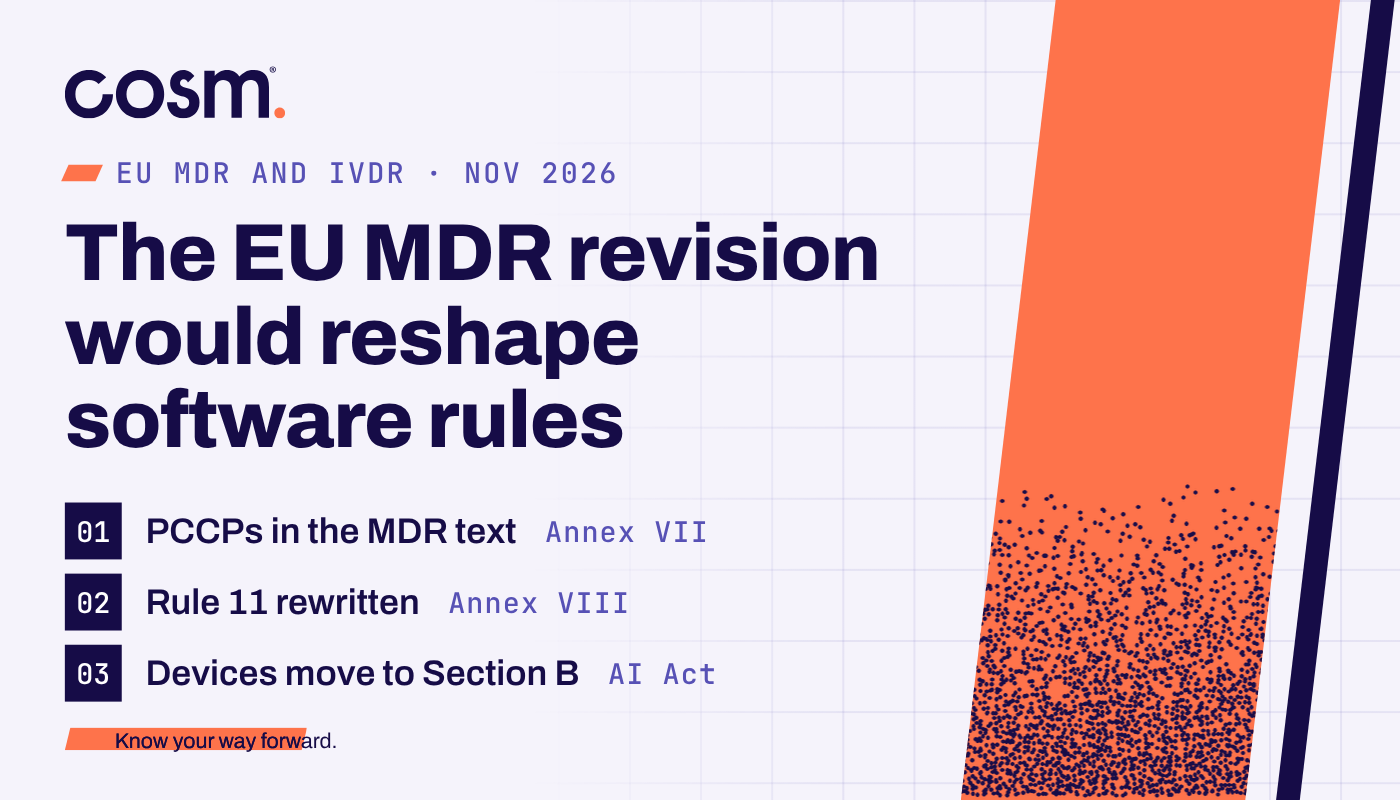
For teams building software and AI devices, four parts of the text matter most. It would let a notified body and a manufacturer agree on a predetermined change control plan, rewrite Rule 11, change how the EU AI Act applies to devices, and add cybersecurity reporting. Below is what the text says, where it stands, and what we suggest doing now.
Where the revision stands
- Commission. The proposal amends the MDR, the IVDR, EMA's support for the expert panels, and Annex I of the AI Act. The text and its annex are on the Commission's publication page, and the proposal is in our document library.
- European Parliament. The Public Health committee (SANT) leads, with Oliver Schenk (EPP) as rapporteur. His draft report came out at the end of June 2026 and amendments were tabled in July. As of early November, the procedure file shows no committee vote yet. It lists December 14, 2026 as an indicative plenary date, while the Council's June progress report expected Parliament to vote in early 2027.
- Council. At a meeting on October 14, member state representatives backed the Irish presidency's aim of a Council position (a general approach) before the end of 2026, according to press reports. Health ministers meet on December 8. Trilogues with Parliament follow once both sides have a position.
- Application. Most changes would apply six months after the amending regulation enters into force. A few would apply from entry into force, including the AI Act Annex I change, the end of the five-year certificate limit and the new transitional provisions. The notified body designation and monitoring changes would follow after 12 months, and the new vulnerability and incident reporting duty after three years. Forecasts for final adoption vary widely, so we would not plan around any one of them.
Predetermined change control plans come to the MDR and IVDR
The proposal adds one paragraph to the notified body requirements on changes, in Annex VII Section 4.9 of both regulations. It reads "Where appropriate, the notified body and the manufacturer shall agree on a predetermined change control plan enabling the manufacturer to implement changes in accordance with such a plan without prior information."
Today, a manufacturer informs its notified body of planned substantial changes before making them, and the notified body decides whether they need a new conformity assessment or a supplement to the certificate. A plan agreed in advance would let the changes it describes go ahead without that prior notice. For AI devices that retrain on a schedule, or software that ships frequent updates, that is a large shift. For high-risk AI devices, MDCG 2025-6 already says that changes pre-determined by the manufacturer and assessed at the initial conformity assessment should not be understood as a change to the certified device. The proposal would put the idea in the regulation itself, for all devices.
The text does not say what a plan must contain, how changes are verified, or where the plan sits in the technical documentation. That will come from MDCG guidance and notified body practice. The closest models today are FDA's PCCP guidance and the IMDRF's PCCP principles, N90, and our PCCP guide covers how to build a plan on those structures.
Rule 11, rewritten
Rule 11 is why almost all medical device software sits in class IIa or higher under the MDR. The proposal rewrites it. Software whose output gives a clinical benefit for diagnosis, treatment, prevention, monitoring, prediction, prognosis, compensation or alleviation of a disease or condition would be class I, unless the output is intended for one of these situations.
- Class III where the condition is critical, with a risk of death or an irreversible deterioration of health.
- Class IIb where the condition is serious, with a risk of a serious deterioration of health or a surgical intervention, or where the output drives clinical management in a critical situation.
- Class IIa where the condition is non-serious, where the output drives clinical management in a serious situation, or where it informs clinical management in a critical or serious situation.
These are the IMDRF SaMD framework's terms, so the analysis lines up with IMDRF guidance, though FDA classification does not use these categories. The rewrite will not, on its own, move much software to class I. Read against the IMDRF framework, class I would cover outputs that drive or inform clinical management in a non-serious situation. Read literally, the class IIa wording could catch any output for a non-serious condition. Either way, informing management in a serious situation stays class IIa, so the class I space is narrow. A review of the Parliament rapporteur's draft by Arnold & Porter found that his amendments "do little to make it easier for medical device software to fall within Class I."
For AI devices the class matters twice. Under Article 6(1) of the AI Act, an AI system that is a device, or a safety component of one, is high-risk when the device has to undergo a third-party conformity assessment. Software that self-certifies as class I would not meet that test.
The AI Act question
Article 4 of the proposal moves the MDR and IVDR from Section A to Section B of the AI Act's Annex I. For products in Section B, the AI Act applies only a short list of its provisions, so its high-risk requirements, from risk management and data governance to human oversight and cybersecurity, would no longer apply directly to devices. Instead, a new MDR Article 5(8), with a matching IVDR provision, would require the Commission to take those requirements into account when it adopts implementing acts, delegated acts and common specifications for devices that are high-risk AI systems under Article 6(1) of the AI Act.
The Digital Omnibus on AI, Regulation (EU) 2026/1744, adopted after the proposal and in force since July 27, 2026, left the MDR and IVDR in Section A (it moved only machinery to Section B). It pushed the high-risk obligations for Annex I products, devices included, back to August 2, 2028, and requires the Commission to adopt delegated acts by August 2, 2027 that may limit specific requirements where Section A product rules, device rules included, give an equivalent or higher level of protection. In the Council's work on the device revision, several delegations support limiting the AI Act's reach for devices, and some want added powers to set device-specific AI requirements. Alignment with AI and cybersecurity law came up again in October.
Until trilogues settle it, plan to the AI Act as it stands. For an AI device that needs a notified body, that means the high-risk requirements from August 2, 2028, built into your MDR technical documentation and quality system as MDCG 2025-6 describes. If the revision enters into force first with the Section B move intact, the move would apply from that day and the high-risk requirements would no longer apply to devices directly.
Cybersecurity, vigilance and post-market changes
- Cybersecurity in Annex I. Section 17.4 would name "IT security measures and cybersecurity, including protection against unauthorised access" among the minimum requirements for running the software.
- Vulnerability and incident reporting. A new Article 87a in the MDR (82a in the IVDR) would require manufacturers to report actively exploited vulnerabilities and severe incidents affecting their devices through EUDAMED, to the national computer security incident response teams (CSIRTs) and ENISA, within 30 days of becoming aware. It would apply three years after the amending regulation enters into force. Devices sit outside the Cyber Resilience Act, so this brings a similar duty into the device rules.
- Vigilance. The general deadline for reporting serious incidents would move from 15 days to 30. The 2-day deadline for serious public health threats and the 10-day deadline for a death or an unanticipated serious deterioration of health would stay.
- PSURs. Class IIb and III devices would update the PSUR in the first year after the certificate and every two years after that, instead of every year. Class IIa devices would update it "when necessary", without today's two-year minimum.
- Certificates. The five-year maximum validity would go, replaced by periodic notified body reviews proportionate to the device's risk.
- Clinical evidence. More room to show safety and performance on non-clinical evidence alone where clinical data are not appropriate (Article 61(10)), in silico testing and computational modeling listed as pre-clinical evidence, and the biological and clinical equivalence criteria relaxed to "same or similar".
What it does not change
The legacy device deadlines stay. Under Regulation (EU) 2023/607, December 31, 2027 applies to class III and most implantable class IIb devices, and December 31, 2028 to the other legacy devices that meet its conditions, which includes most legacy software. For IVDs, the dates set by Regulation (EU) 2024/1860 also stay. They are December 31, 2027 for class D, December 31, 2028 for class C and December 31, 2029 for class B and sterile class A. The proposal adds an exception for orphan devices but does not move the dates. Until the amending regulation applies, the MDR and IVDR apply as written.
What this means for software and AI device teams
- Keep building to today's MDR and IVDR. Nothing in the proposal applies yet. The legacy deadlines and notified body capacity drive most plans whatever happens. The AI Act date of August 2, 2028 holds unless the revision enters into force first with the Section B move intact.
- Write your PCCP once, for both markets. Structure the description of modifications, the modification protocol and the impact assessment in your FDA PCCP so the same content could support a notified body agreement later. For a high-risk AI device in the EU today, pre-determined changes set out in the technical documentation and change control procedure can be assessed at conformity assessment, as MDCG 2025-6 describes. Any other substantial change still goes to the notified body first.
- Revisit your Rule 11 rationale, but do not plan on class I. Map each output to the IMDRF terms (the situation, and whether the output informs, drives, diagnoses or treats). That analysis is useful under today's guidance in MDCG 2019-11 and would carry over to the new rule.
- Build AI Act evidence that can flex. Integrate the high-risk requirements into your MDR technical documentation and QMS, so the work counts whether devices stay in Section A, move to Section B or see requirements trimmed by delegated act.
- Get vulnerability handling ready to report. If you already run coordinated vulnerability disclosure and SBOM monitoring for FDA (our SBOM guide covers the fields), add an EU path for actively exploited vulnerabilities.
- Watch the Council position. It is the next marker, and it will show whether member states keep the PCCP paragraph, the Rule 11 rewrite and the Section B move.
Caveats
This is a proposal. Parliament's committee has a large number of tabled amendments to work through and the Council text is still moving, so any of these provisions could change or drop out in trilogues. Article and annex numbers follow the Commission's text and may shift. How notified bodies apply the new provisions will depend on guidance that does not exist yet.
The bigger picture
The EU has just reset the AI Act timeline and is now revising its device rules, and the two texts do not yet agree on how AI devices should be regulated. Our post on the Digital Omnibus and the new AI Act dates covers the AI Act side, and MDCG 2025-6 sits next to the Commission's proposal in our library. For more on EU work, see our International topic page.
How Cosm Can Help
Cosm works with software and AI device teams on EU and US regulatory strategy, including Rule 11 classification, MDR technical documentation, PCCPs that can serve both FDA and a notified body, and building AI Act requirements into an ISO 13485 QMS. If you want to assess how the revision could affect your device or your EU timeline, talk to Cosm.
Disclaimer - https://www.cosmhq.com/disclaimer
