


.png)
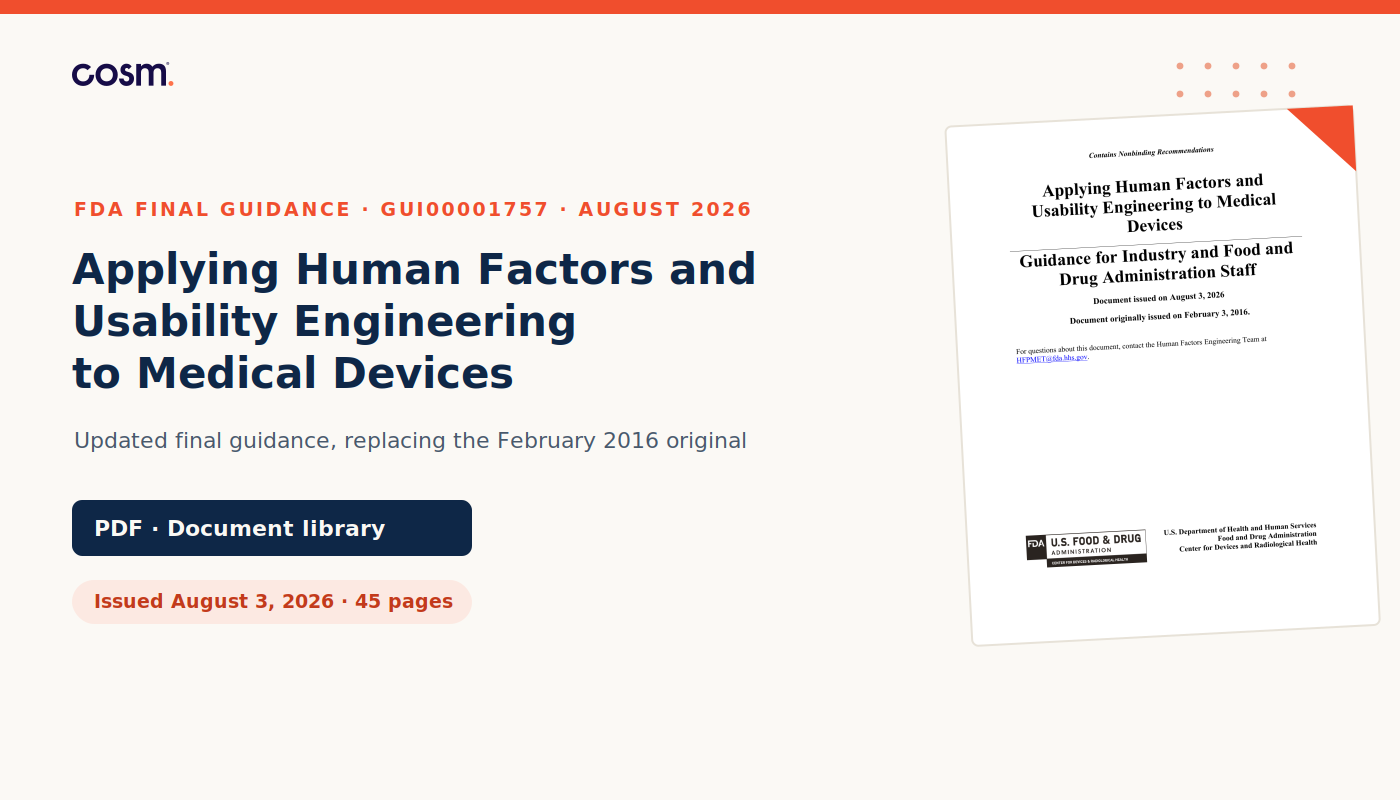


On August 3, 2026, FDA's Center for Devices and Radiological Health (CDRH) issued an updated version of Applying Human Factors and Usability Engineering to Medical Devices (docket FDA-2011-D-0469), the agency's core guidance on how to run a human factors engineering (HFE) program for a medical device. The original was issued in February 2016, and for a decade it has been the reference document behind nearly every use-related risk analysis, formative study, and human factors validation test submitted to CDRH.
The 2026 update is a harmonization pass rather than a policy rewrite. The core expectations are intact, but the framework around them has been modernized to match the Quality Management System Regulation (QMSR), current consensus standards, and the final guidance on human factors content in marketing submissions that FDA issued in May 2026. If your human factors SOPs, templates, and protocols cite the 2016 version, this update is your cue to bring them current. Below is what changed, what did not, and what to do about it.
What This Guidance Covers
This guidance is the "how" document of FDA's human factors framework. It recommends that manufacturers apply HFE/UE processes throughout development of a new device, focused on the user interface: every point of interaction between the user and the device, including displays, controls, packaging, labeling, instructions for use, and training.
The organizing principle is unchanged and worth restating because it drives everything downstream: because the probability of a use error is very difficult to estimate, FDA considers the severity of the potential harm the meaningful input for deciding where HFE effort goes. Tasks that could cause serious harm if performed incorrectly or not at all are critical tasks, and the whole process (preliminary analyses, formative evaluations, risk controls, and human factors validation testing) is built around identifying them and demonstrating that the final user interface supports safe and effective performance of them.
What Changed in the 2026 Update
Alignment with the QMSR. The guidance now anchors its design control and risk management expectations to the revised 21 CFR Part 820, which incorporates ISO 13485:2016 by reference and took effect on February 2, 2026. References to the old Quality System Regulation framing are gone. For manufacturers, this closes a loop: your human factors process is now described by FDA in the same quality system language your QMS was just transitioned into.
Updated standards and terminology. Citations have been refreshed to ISO 14971:2019 and IEC 62366-1:2015 with its 2020 amendment, and the language follows suit: the guidance speaks of risk control measures, in ISO 14971's preferred ordering of inherent safety by design, then protective measures, then information for safety. The definitions section has been expanded to include use-related risk analysis (URRA), use safety, serious harm, residual risk, normal use, and abnormal use, matching the vocabulary FDA now expects to see in submissions.
A clean split between process and submission content. The 2016 version included an appendix describing the recommended HFE/UE report. That appendix is gone. The documentation section now simply points to the companion final guidance, Content of Human Factors Information in Medical Device Marketing Submissions (May 2026), which defines the three-category framework for what actually goes in a 510(k), De Novo, PMA, or HDE. The division of labor is now explicit: this guidance tells you how to do the work, the companion guidance tells you what to submit.
Worked examples for analyzing validation results. The updated guidance includes an appendix walking through hypothetical human factors validation findings in a structured format: the observed task failure, the user's comments, the clinical consequence and potential harm, the possible root cause, candidate risk controls, and how the effectiveness of each control would be evaluated. It is a practical template for the root cause analysis FDA expects when use errors, close calls, or difficulties show up in validation testing, and it reinforces that "test artifact" explanations are acceptable only sparingly.
What Stayed the Same
The fundamentals that regulatory and human factors teams have built their processes on remain in place:
- Critical tasks are identified through preliminary analyses (task analysis, FMEA, FTA, heuristic and expert review, contextual inquiry, formative evaluations) and categorized by severity of potential harm, not probability.
- Human factors validation testing needs a minimum of 15 participants per distinct user population, with participants who reside in the US, no company employees, and a production-equivalent user interface with final labeling.
- Training given to test participants should approximate real-world training, with time allowed for training decay. The think-aloud technique remains unacceptable in validation testing.
- Claiming you will mitigate observed use errors with labeling changes or "additional training" is not acceptable in a premarket submission without data demonstrating the fix works. Deferring design fixes to a future device version is likewise not acceptable.
- FDA continues to encourage submitting draft validation protocols for feedback through the Q-Submission program before testing.
What This Means for Device Developers
Update your SOPs and templates. Any procedure, work instruction, or protocol template that cites the 2016 guidance, the old 21 CFR 820.30 framing, or pre-2019 editions of ISO 14971 should be revised. This is a focused documentation update, not a process overhaul, but auditors and reviewers will notice stale references.
Treat the two 2026 guidances as a pair. Your HFE process should follow this guidance; your submission package should be scoped by the content guidance's three-category framework. Teams that only read one of the two will either do the work and present it poorly, or present a tidy package built on a weak process. Both fail review.
Make the URRA your central artifact. With URRA now defined in both guidances, a structured use-related risk analysis that traces tasks, use errors, severity, critical task designation, risk controls, and validation evidence is the connective tissue between your risk file and your submission. If you do not maintain one in a defensible format, build that capability now.
Revisit plans for modified devices. The guidance retains its expectation that modifications, including those made as corrective actions for use-related problems, are assessed through the same risk-based process, with validation testing focused on the affected tasks. Combined with the comparative URRA expectations in the companion guidance, modification-heavy 510(k) pipelines should standardize this workflow.
Use the appendix examples internally. The worked residual-risk analyses are a ready-made structure for your own validation report discussions and for training study staff on what root cause analysis needs to look like before FDA sees it.
The Bigger Picture
Taken together with the May 2026 content guidance, FDA has now refreshed its entire human factors framework within a single year, and both documents are aligned with the QMSR that took effect in February. The direction is consistent: human factors is treated as an integral part of risk management under ISO 14971 and ISO 13485, not a standalone study bolted on before submission. We covered the companion guidance in detail in FDA Finalizes Human Factors Content Guidance for Marketing Submissions, and our practical walkthrough of building a validation protocol is in Human Factors Validation for Medical Devices.
The full guidance PDF is also available in our resources document library.
How Cosm Can Help
Cosm specializes in FDA regulatory and quality strategy for medical devices, SaMD, and AI/ML digital health. If you are updating your human factors procedures for the QMSR era, building a URRA for the first time, scoping the HF portion of an upcoming submission, or preparing a validation protocol for Q-Sub feedback, contact us or visit www.cosmhq.com to discuss how we can support your program.
Disclaimer - https://www.cosmhq.com/disclaimer
