


.png)
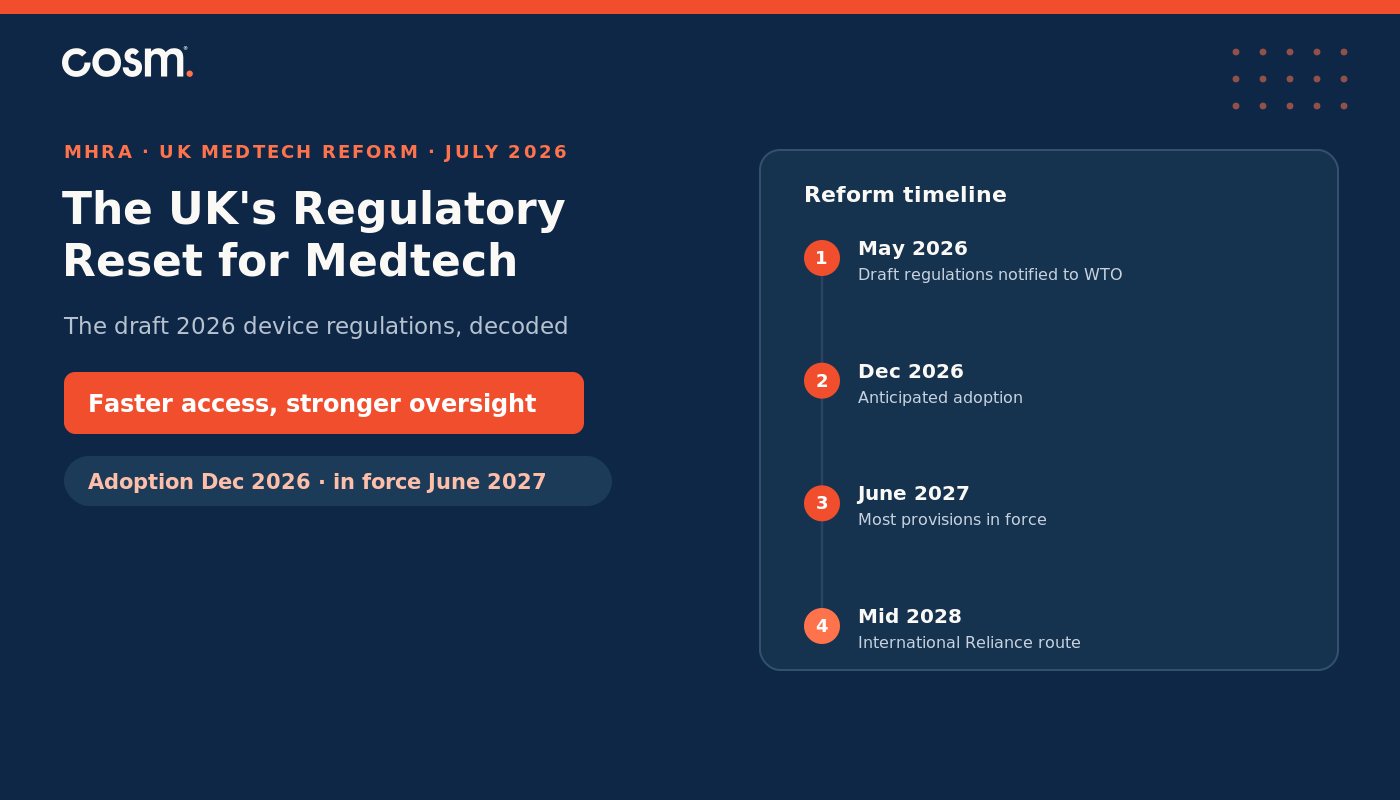


Over the past two months the MHRA has moved from talking about reform to writing it down. On 8 May 2026 it notified the draft Medical Devices (Amendment) Regulations 2026 to the World Trade Organisation and opened a stakeholder impact survey that closed on 19 June. On 2 July, MHRA Chief Executive Lawrence Tallon set out the philosophy behind the change in a widely shared piece arguing that regulation should "help to lead" innovation rather than follow it. Alongside both sits the MHRA's Innovation Accelerator, the agency's front door for developers who want scientific and regulatory advice earlier. Below is what these developments say, and what they mean if you are building or placing a medical device on the Great Britain market.
The reset in one sentence
The draft regulations replace much of the ageing UK Medical Devices Regulations 2002 with a framework that draws on the EU MDR and IVDR, aligns with International Medical Device Regulators Forum (IMDRF) practice, and adds a reliance route to comparable regulators. The through-line from the MHRA's leadership is faster access paired with stronger post-market accountability. For manufacturers, that means more ways in and a higher bar to clear once you are in.
What is changing in the draft regulations
The draft Medical Devices (Amendment) Regulations 2026 focus on pre-market requirements for devices and in vitro diagnostics entering the GB market. The headline reforms are:
1. International Reliance
The draft introduces a stand-alone route to the GB market for devices already authorised by regulators in Australia, Canada, and the United States. Eligible devices can obtain a Certificate of International Reliance without going through UKCA marking. This is a significant change in market-access strategy: for a device already cleared by, say, the FDA, GB entry becomes a reliance exercise rather than a fresh conformity assessment. Note two limits. The EU is not part of this route, and the reliance pathway is expected to follow the main regulations, arriving around mid-2028.
2. Classification and essential requirements re-anchored to international practice
The draft revises classification rules for general medical devices, active implantable devices, and IVDs, with IVD classification aligned to IMDRF standards. It also re-anchors the essential requirements for GB devices on EU MDR and IVDR concepts, modified for the UK framework. If your product currently sits in a low-friction class, re-classification is the first thing to check, because it can pull in new conformity assessment and clinical evidence obligations.
3. Traceability: mandatory UDI and implant cards
Unique Device Identifiers become compulsory across devices and IVDs, and healthcare organisations that implant devices will be required to give patients implant cards. Technical documentation retention is extended to the lifetime of the device plus 10 years, and 15 years for implantable devices, to support post-market surveillance and vigilance.
4. A PCCP pathway for software, with cybersecurity built in
The draft creates a Predetermined Change Control Plan pathway for software medical devices, intended to let manufacturers pre-authorise a defined envelope of changes rather than returning for each update. It pairs this with explicit cybersecurity obligations. For SaMD and AI/ML developers, this is the most consequential single provision: it maps a route for the iterative updates that modern software depends on.
5. Claims and equivalence tightened
The draft tightens the rules on claims of equivalence to existing devices, introduces controls on misleading or unsubstantiated claims, and requires that claims about a device align with its stated intended purpose. Marketing copy and clinical claims now need to trace cleanly back to the intended-purpose statement in your technical file.
The bigger strategy behind it
The regulations are not a standalone document. They sit inside a broader MHRA push that its CEO has now made explicit. In his 2 July piece, Lawrence Tallon argued that the common thread across the agency's strategy is to "shorten timelines, reduce requirements that have low impact, and speed the generation of new therapies to patients." He pointed to a new rare disease framework that replaces the traditional three-phase clinical trial and licensing route with an iterative Investigational Marketing Authorisation, and to the National Commission on AI in healthcare, whose final report is due in September and which he expects to point to "fundamental changes."
The Innovation Accelerator is the operational side of that ambition. It gives innovators, from large manufacturers to academics and patient groups, access to MHRA scientific expertise and regulatory guidance earlier in development, bringing together the Innovation Office, the Regulatory Advice Service for Regenerative Medicines, regulatory science and horizon scanning, and support for the Innovative Licensing and Access Pathway. The policy goal behind all of it, set out in the Life Sciences Sector Plan, is for the UK to become one of the top three fastest countries in Europe to access medtech by 2030.
What this means for developers
Map your portfolio against the draft now. Adoption is anticipated around December 2026, with most provisions in force in June 2027. That is a short runway for the documentation, UDI, and PMS changes the draft requires. Waiting for the final text before assessing gaps leaves too little time.
Re-examine your market-access route. If you hold a US, Canadian, or Australian authorisation, International Reliance may become the most efficient path into GB, but it arrives later than the core regulations (mid-2028) and excludes the EU. CE-mark recognition is being handled through a separate MHRA process, so GB strategy now has several moving parts to weigh together.
Build your PCCP thinking early if you ship software. The PCCP pathway rewards teams that can define, up front, the envelope of changes they expect to make and the methods they will use to validate them. That is a design and quality-system exercise, not just a regulatory filing.
Reconcile claims with intended purpose. Audit marketing and clinical claims against your intended-purpose statement before the tighter rules bite. Divergence that was tolerated before will become a compliance exposure.
Plan for longer retention and stronger traceability. UDI, implant cards, and multi-decade documentation retention are operational commitments. They touch labelling, systems, and supplier agreements, so they are cheaper to build in than to retrofit.
Caveats worth holding in mind
This is still a draft. The impact survey that closed on 19 June will feed the formal impact assessment, and details can move before adoption. Approved Body capacity is a known pressure point for the transition, and the interaction between the reformed GB framework and the European Commission's own proposals to simplify the EU MDR and IVDR could widen divergence for companies selling into both markets. The direction of travel is clear; the exact contours are not yet fixed.
The bigger picture
What the UK is describing is a regulator trying to compete for medtech investment on speed and openness while raising the floor on safety and traceability. For companies that treat regulatory strategy as a design input rather than a final hurdle, this is an opportunity: an earlier advice channel, a reliance route that can save a full conformity assessment, and a software pathway built for iteration. For companies that wait, it is a compressed timeline against a longer list of obligations. For a related read on how software and AI change the regulatory calculus, see our earlier post on AI/ML medical device regulation on the Cosm blog.
You can read the full draft Medical Devices (Amendment) Regulations 2026 in the Cosm resources library: https://links.cosmhq.com/4glur1r.
How Cosm Can Help
Cosm helps medical device, IVD, SaMD, and AI/ML companies build regulatory and quality strategy that holds up across jurisdictions. We can map your portfolio against the draft Medical Devices (Amendment) Regulations 2026, assess whether International Reliance is the right GB route for a given product, structure a PCCP for your software, and align your technical documentation, UDI, and claims ahead of the transition. If you want a clear read on what these reforms mean for your submissions, get in touch or visit cosmhq.com.
Disclaimer - https://www.cosmhq.com/disclaimer
