


.png)
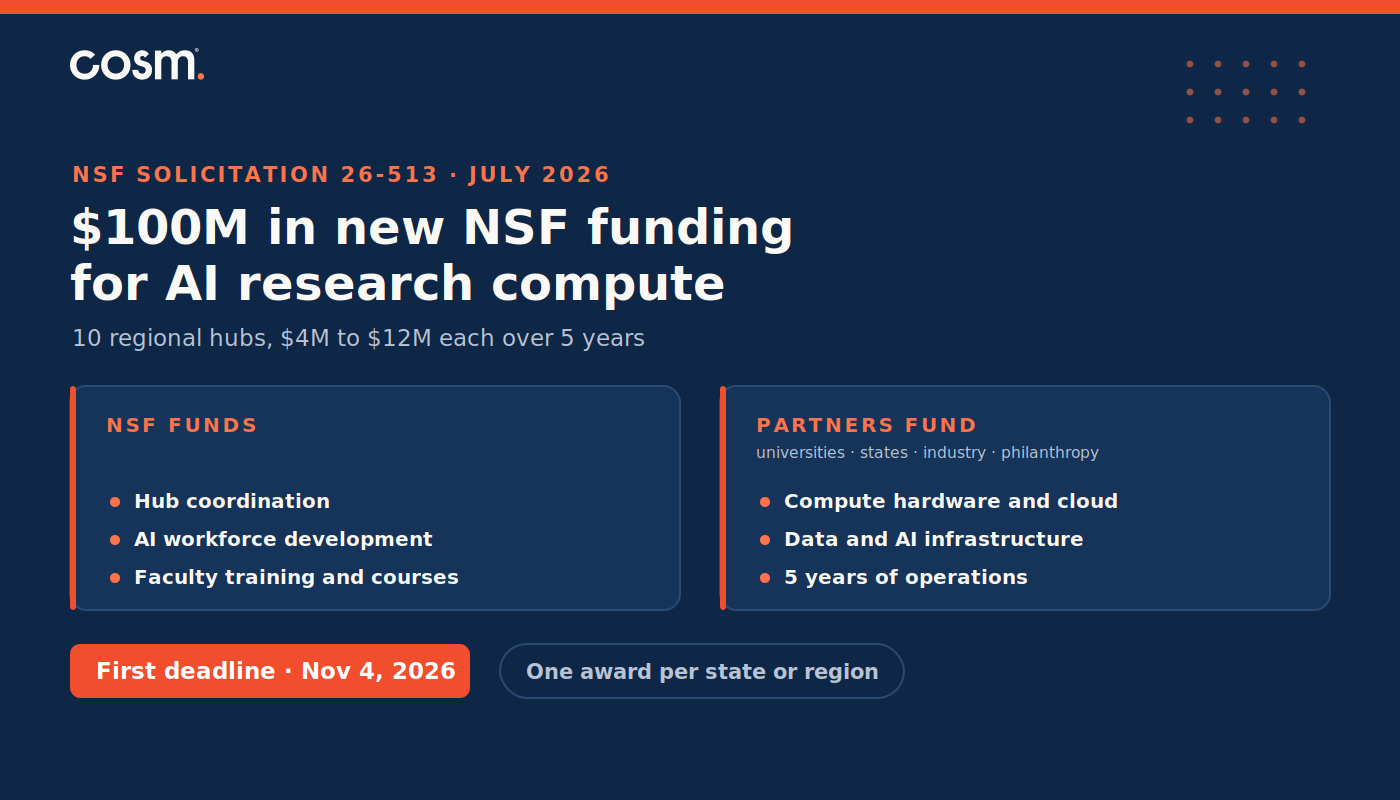


On July 31, 2026, the U.S. National Science Foundation posted solicitation NSF 26-513, "State and Regional Artificial Intelligence Infrastructure Hubs: Expanding Access to Compute for Scientific Discovery." The program will invest approximately $100 million in up to 10 state or multi-state consortia per cycle, each funded at $4 million to $12 million over 5 years, with the first full proposal deadline on November 4, 2026. The stated goal is to expand access to the computing power required for AI-enabled scientific discovery, well beyond the small set of institutions that currently have it.
This is a funding solicitation rather than a regulatory document, but it deserves attention from medtech AI teams. The hubs it creates will shape where academic AI research capacity, training data infrastructure, and AI-skilled talent concentrate over the next five years, and the program explicitly requires industry partnership. Below is what the solicitation says and what it means if you develop AI/ML-enabled medical devices.
What the program is
The AI Infrastructure Hubs program funds consortia, led by universities or non-profit research organizations, that aggregate computing, data, and AI resources for researchers across a state or multi-state region. Only one award will be made per state or region, so each hub is intended to become the coordinating point for AI research infrastructure in its geography. Awards are cooperative agreements, which means NSF stays actively involved in oversight rather than simply granting funds.
The most distinctive feature is the funding model. NSF does not pay for the computing hardware. The solicitation states that NSF does not provide funding for acquisition of AI infrastructure, and consortia are responsible for separately raising that funding through partnerships with the private sector, philanthropy, and state and local governments. What NSF funds is everything that makes the infrastructure usable: consortium coordination, the technical workforce that operates the systems, faculty training, and instructional material development. On-premises and cloud models are both acceptable, and consortia must document funding commitments covering five years of operations.
The five required elements
Every proposal must address five components, which together give a good picture of what these hubs will actually do.
1. Consortium stakeholders, vision, and deliverables. A governance structure, a membership strategy that reaches a wide range of institution types (community colleges included), and concrete deliverables across compute, research, and workforce development.
2. Computing, data, and AI infrastructure. The resources the consortium will acquire or build, with committed funding from non-NSF sources and a high-level infrastructure description in the proposal.
3. Partnerships with regional stakeholders. Each hub must engage at least one regional industry or non-profit partner, and coordination with the National AI Research Resource (NAIRR) and AI-Ready America initiatives is expected.
4. AI infrastructure workforce development. Teams of systems administrators, architects, engineers, and "AI for science facilitators" who support researchers, plus education pathways with stackable credentials through postsecondary and continuing education.
5. Faculty training and instructional materials. Five to ten new or enhanced courses or workshops built to use the hub's resources, with materials shared across consortia and encouraged for NAIRR distribution.
What is notable in the fine print
A few details stand out for anyone tracking how this program will play out. Merit review adds solicitation-specific criteria on governance strength, workforce plans, the credibility of committed partners, and whether the proposed infrastructure is adequate in scale and design for the consortium's researchers and students. The solicitation also notes that, all else being equal after merit review, NSF may give preference to institutions with lower indirect cost rates (per Executive Order 14332). Proposals are submitted as a single award with subawards, one proposal per organization per competition, and states that need more development time can submit planning proposals instead. Deadlines recur annually, on the first Wednesday of November, so a region that is not ready in 2026 gets another shot in 2027.
Hubs are also expected to measure success in concrete terms: scientific output and follow-on funding, student outcomes and workforce training in areas like data engineering, cybersecurity, and GPU programming, community-of-practice formation, and infrastructure utilization.
What this means for medtech AI developers
Medical device companies are not the applicants here, but they are named in the design of the program. Several implications are worth acting on.
Industry partnership is a required element, not a nice-to-have. Every hub must engage at least one regional industry or non-profit partner, and partnering industry is expected to help shape workforce development so training matches regional job market needs. In return, the solicitation describes research partnerships and collaboration between regional industries and researchers using the consortium's resources. For a medtech AI company, that is a structural opening: a seat at the table in how your region's AI research capacity gets built, and a channel to the academic groups doing clinical AI work near you.
The talent pipeline is the same one you hire from. The workforce the hubs are chartered to produce (data engineers, research software engineers, model deployment specialists, GPU programmers) maps directly onto the skills AI/ML device teams struggle to recruit. Companies that engage early, through internships, co-developed curricula, or advisory roles, will have first access to that pipeline.
Academic collaborators get real compute. If your clinical validation studies, algorithm development, or postmarket research run through university partners, those partners may soon have substantially better infrastructure for model training, testing, and evaluation. That affects what is feasible in collaborative studies, and it is worth knowing which consortium your partner institutions are joining.
The NAIRR connection extends the runway. Hubs must engage with the National AI Research Resource to share resources and lessons learned. For biomedical AI research, which already routes through NAIRR pilot resources, the hubs add regional on-ramps to national compute. Teams building evidence for AI-enabled devices should watch how these access pathways develop.
Timing matters. Consortia are forming now against a November 4, 2026 deadline. If you want a voice in your region's hub, the conversation with your state's research universities should happen in the coming weeks, not after awards are announced.
Caveats
A few cautions before anyone reorganizes their roadmap around this. The infrastructure itself depends on non-NSF fundraising, so a hub's actual capacity will vary with how much its region raises. One award per state or region means some strong proposals will not be funded, and coverage will be uneven for the first cycles. And the solicitation is aimed at scientific discovery broadly, not at biomedical applications specifically, so the degree to which any given hub serves health and life science research will depend on who is in its consortium and which partners showed up early. That last point is an argument for engagement, not against it.
The bigger picture
The program is part of a broader federal push to distribute AI research capacity beyond a few coastal clusters and a handful of large companies, alongside NAIRR and the AI-Ready America coordination hubs. For medtech, the direction of travel is clear: more institutions with the compute to do serious AI work means more potential collaborators, more trained talent, and rising expectations for the rigor of AI development and validation. Teams that want a structured way to think about that rigor across the product lifecycle can start with our playbook on the FDA's AI Lifecycle Management model.
The full solicitation is available on the NSF website: NSF 26-513.
How Cosm Can Help
Cosm helps companies developing AI/ML-enabled medical devices and SaMD navigate FDA regulatory strategy, quality systems, and submission planning, from early development through clearance and postmarket. If you are building AI research partnerships and want to make sure the resulting evidence supports your regulatory path, get in touch or visit cosmhq.com.
Disclaimer - https://www.cosmhq.com/disclaimer
