


.png)
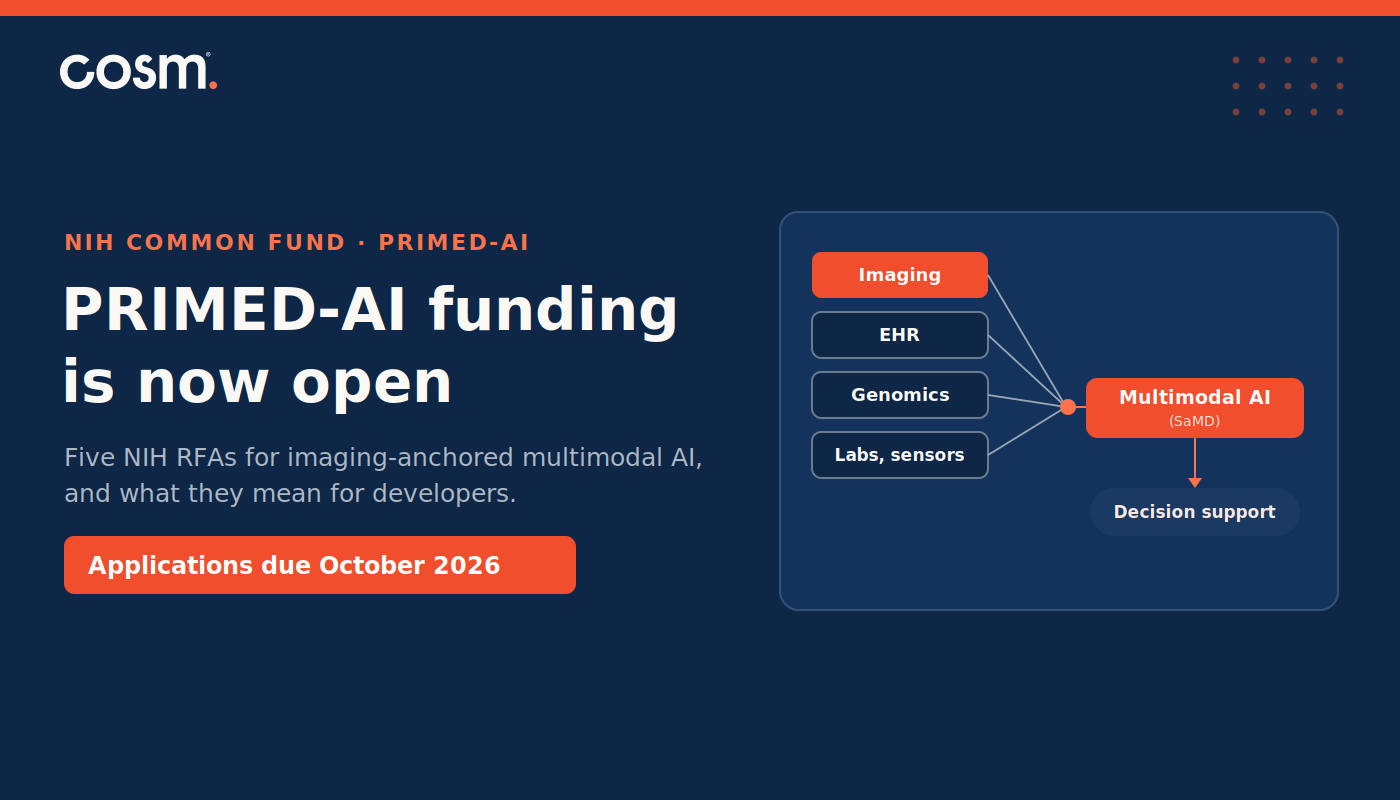


The NIH Common Fund has opened the first funding opportunities under PRIMED-AI, its program for Precision Medicine with AI: Integrating Imaging with Multimodal Data. The program concept was approved by the NIH in April 2025, and after a landscape analysis, a public Request for Information, and a two-day expert workshop, it has now moved from planning to five live Requests for Applications. Below is what the program is, how the funding is structured, and what it means if you are building imaging-based AI as a medical device.
What PRIMED-AI is
Clinical imaging carries dense, objective information, but most AI tools built on it read a single modality in isolation: a chest radiograph, a retinal photo, a pathology slide. Patient health is not single-modality. A diagnosis draws on imaging alongside the electronic health record, labs, genomics, and increasingly wearables and other sensors. PRIMED-AI is a coordinated, disease-agnostic Common Fund program that funds the harder problem: AI that anchors on medical imaging and integrates it with other health data to support clinical decision-making, then validates those tools and moves them toward the clinic.
The framing matters for developers. This is not a basic-research or pure-algorithm program. It is translational and team-based, built around four pillars the strategic-planning workshop identified: building trust and coordination, imaging and multimodal data integration, AI algorithm and tool development, and clinical implementation. Data sharing, benchmarking, transportability across sites, and ethics run through all of it.
How the funding is structured
Five RFAs are now open, and for-profit organizations, including small businesses, are explicitly eligible across them. They form a pipeline from framework-building through tool development, validation, and clinical translation:
- Data-to-Model Academic-Industrial Partnership. The most industry-facing opportunity. It requires a genuine academic and industry partnership, with multiple principal investigators from each side, and a Software-as-a-Medical-Device deliverable that integrates imaging with real multimodal data. Applications are due in October 2026.
- Model-to-Clinic. For teams with an already-validated prototype ready to advance toward clinical application with demonstrated potential for patient impact.
- Multi-use Frameworks Playbook. Develops standardized processes for the field, including data management and regulatory preparation. Applicants must propose at least two distinct frameworks. Roughly 300,000 dollars in direct costs per year, up to two years.
- Validation Center and Logistics Center. Independent validation and coordinating-center infrastructure for the consortium. These are large-institution roles rather than single-product plays.
What the program expects
Read across the RFI, the workshop summary, and the RFAs, and a consistent set of expectations emerges. These are the parts a regulatory or product lead should internalize before drafting anything.
Imaging is the required anchor. The program is disease-agnostic, so you bring your own condition, but imaging is not optional. The RFAs name radiologic, ophthalmic, endoscopic, and dermatologic imaging as anchor modalities. Digital pathology can complement the anchor but cannot be the sole modality. The test for fit is simple: is imaging central, and is multimodal integration the point rather than an afterthought.
Validation and transportability are first-class. The workshop was blunt that models effective at one site are often not effective across sites, that tools to measure transportability are underdeveloped, and that multi-site prospective studies are needed. Expect to justify generalizability, not just report a single-site AUC.
Data sharing is a condition, not a courtesy. The program builds on NIH's data-sharing requirements and the open-commons model exemplified by MIDRC. Teams should plan for deidentified, harmonized, well-labeled data and for contributing to shared benchmarks.
What this means for developers
The ideal applicant already builds imaging SaMD. If your product anchors on radiologic, ophthalmic, endoscopic, or dermatologic imaging and you either integrate, or want to integrate, other data types, you are the target. Pure hardware, non-imaging AI, and single-modality tools with no path to integration are weaker fits.
Partnerships are structural, not optional. The Data-to-Model track requires paired academic and industry leadership. Industry teams need a clinical and academic partner for data access and validation, and academic labs need an industry partner for translation and a regulatory pathway. Identify that partner early, because the application depends on it.
Regulatory thinking is built in. Every awardee must submit an error mitigation and technical management plan, and the program repeatedly foregrounds fit-for-purpose evaluation, monitoring, and FDA readiness. The teams that do well will treat the regulatory strategy as part of the science from day one, defining intended use, user type, and clinical workflow placement up front rather than retrofitting them.
Single-modality does not automatically qualify. Many strong imaging-AI companies today ship a narrow, single-modality reader. PRIMED-AI rewards fusion. If your current device is single-modality, the credible PRIMED-AI story is how you extend it to integrate the EHR, genomics, or other signals, and what clinical question that unlocks.
Caveats worth flagging
Eligibility geography. NIH Common Fund awards generally require a US applicant institution. Foreign for-profits usually cannot be the direct awardee, though they can join as an industry partner or subcontractor to a US academic lead. For non-US developers, the play is to pair with a US academic medical center, not to apply directly.
The timeline is real. The deadlines fall across October 2026. Building a credible academic-industrial partnership, securing data access, and drafting an error mitigation plan is not a two-week exercise. The teams that start scoping now are the ones that will be ready.
The bigger picture
PRIMED-AI is a signal about where imaging AI is heading: away from isolated single-modality readers and toward validated, multimodal tools that regulators and clinicians can trust across sites. The program's emphasis on transportability, monitoring, and error mitigation mirrors exactly the questions the FDA is asking of AI-enabled devices in the market today. For a closer look at one of those questions, see our guide on data drift in medical machine learning, which covers the post-market monitoring expectations that a PRIMED-AI error mitigation plan will need to address.
How Cosm Can Help
Cosm provides regulatory strategy, quality, and product-development support for AI/ML medical device and SaMD companies. We help teams define intended use and clinical claims, select predicates, design clinical validation and transportability studies, and build the error mitigation and technical management plans that programs like PRIMED-AI, and the FDA, now expect. If you are weighing a PRIMED-AI application or need a US regulatory partner for a multimodal imaging AI tool, we can help you scope it. Reach us at info@cosmhq.com or at cosmhq.com.
Disclaimer - https://www.cosmhq.com/disclaimer
