


.png)
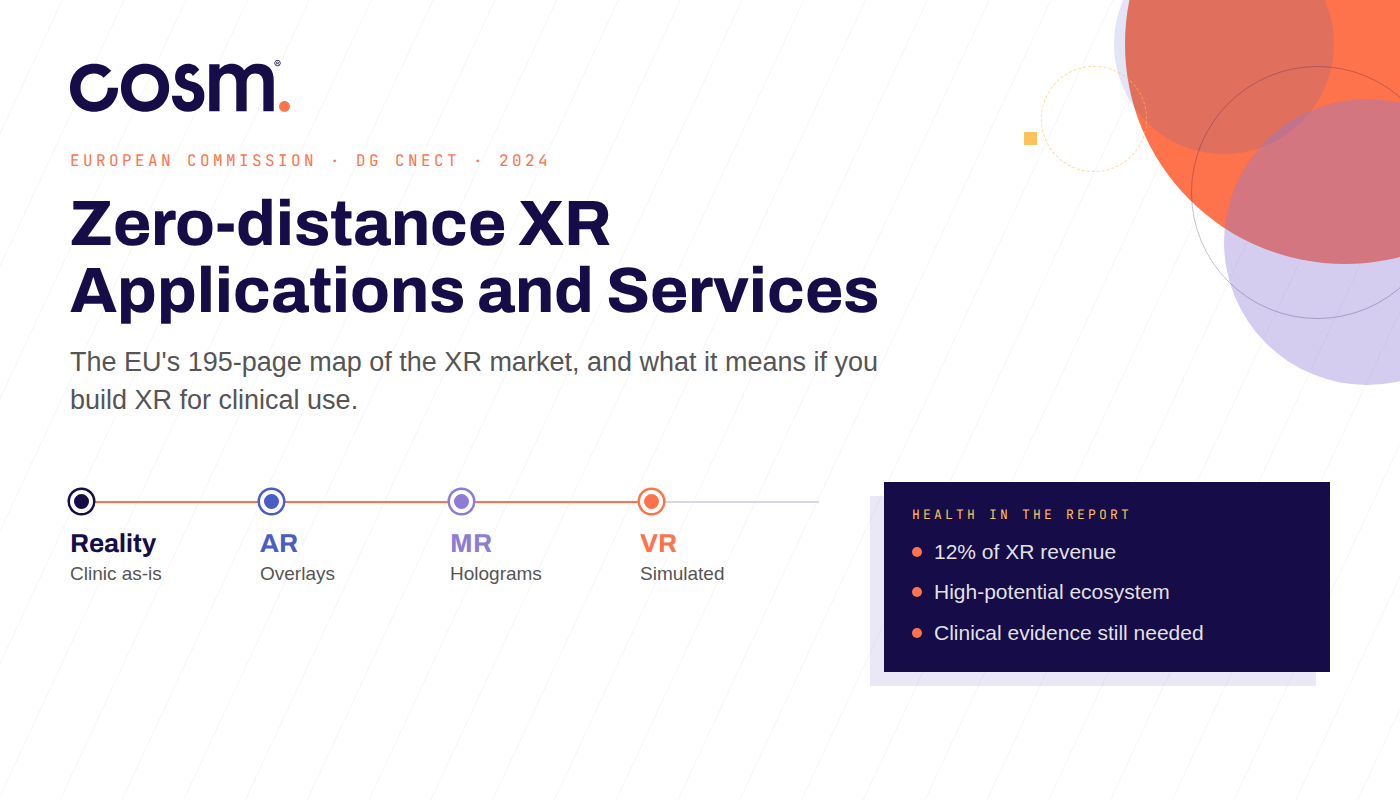


The European Commission's Zero-distance XR Applications and Services final report is the most complete public map of the European extended reality (XR) market that we know of, and it is a useful reference for anyone deciding where augmented, virtual, or mixed reality fits in a medical device roadmap. The 195-page study was prepared for the Directorate-General for Communications Networks, Content and Technology (DG CNECT) by Visionary Analytics in cooperation with Ecorys, Idea Consult, Statista, Brian Waterfield, and Christoph Runde. The manuscript was completed in November 2023 and published by the Publications Office of the European Union in 2024 under a Creative Commons Attribution 4.0 licence (doi:10.2759/0405). It is a policy study rather than a regulatory document, so nothing in it is binding. It tells you how European policymakers see the XR market, where health sits in that picture, and which barriers they consider serious enough to act on. We have added the report to the Cosm document library. Below is what it is, what it covers, and what it means if you are building an XR product for clinical use.
What the report is
The study set out to understand how XR could support what the Commission calls zero-distance business models, meaning services that shorten the distance between a company and its customers, and to recommend EU-level policy measures that would strengthen European industrial competitiveness in XR and virtual worlds. It defines XR as the umbrella term for VR, AR, and MR, together with the sensing, data processing, and rendering stack behind them, and it treats virtual worlds and the metaverse as adjacent concepts in line with the Commission's July 2023 Communication on Web 4.0 and virtual worlds.
The evidence base is broad. The team combined desk research with an analysis of XR projects funded through Horizon 2020 and Horizon Europe and procured through Tenders Electronic Daily, 49 interviews with stakeholders from 15 EU Member States and six non-EU countries, attendance at 12 industry events, eight case studies of public XR initiatives in the United Kingdom, South Korea, the United States, the United Arab Emirates, Australia, Argentina, South Africa, and Brazil, a two-round Delphi survey (109 expert responses in the first round and 23 in the second), and two online workshops in June and September 2023. The landscape analysis is organised around the Commission's 14 industrial ecosystems, one of which is health, and the geographic scope is the EU27 plus the countries associated with Horizon Europe.
What it covers
Chapter 2: The XR landscape
This is the largest chapter and the one with the most practical content. It opens with a financing analysis: funding raised by EU-headquartered XR companies grew steadily from 2016 through 2022, but the study estimates that US XR companies raised roughly 14 times more over the same period, and that seed and early-stage rounds account for more than 95 percent of EU funding rounds, which the authors read as a scale-up gap for mid-sized companies. The chapter then assesses how relevant XR is to each of the 14 ecosystems, catalogues what each ecosystem needs for broader deployment (hardware, software, infrastructure, content, and standards), classifies the barriers to adoption as technological, business, financial, societal, or legal, and closes by identifying the ecosystems with the highest potential for EU competitiveness.
Chapter 3: Public initiatives
An inventory of XR and virtual-worlds initiatives in the EU and the Horizon Europe associated countries, broken down by geographic scope, material scope, and primary area of intervention, plus deep dives into the eight non-EU case studies to see which models could be transferred to Europe.
Chapter 4: Emerging technologies
A survey of the technologies most likely to change what XR can do: novel photonics for displays, optics and sensing including haptics, 5G and 6G and Wi-Fi 6/7 connectivity, cloud and edge computing, advanced semiconductors, graphene and metamaterials, blockchain, and artificial intelligence. The Delphi experts ranked AI as the most important of these, with 51 percent rating it very important to XR development.
Chapter 5: Virtual worlds in the EU
An overview of the virtual worlds currently operating in Europe, their users and application domains, business models, and the technologies that run them.
Chapter 6: Conclusions and recommendations
Six recommendation themes for the Commission, summarised further below. Ten annexes hold the detailed methodology, source lists, interview and Delphi questionnaires, the eight case studies, the workshop report, financing cases, suggested areas for further research, and the report of the September 2023 presentation event.
Where health sits in the picture
The health section of the landscape analysis is short but pointed. The study rates the level of XR deployment in health as high compared with other ecosystems, with the most activity in Germany, the Netherlands, and France, and cites an industry estimate placing healthcare third by XR revenue at about 12 percent of the market (roughly 1.19 billion euros), behind media and entertainment and industrial manufacturing. Health is then named as one of four ecosystems with the highest potential for EU competitiveness, alongside construction, aerospace and defence, and automotive, because XR is already in use across several segments of the value chain.
The use cases the report lists are worth reading closely because most of them describe medical device functions rather than general-purpose software: medical training and simulation; preoperative planning that turns CT angiography and MR angiography data into 3D models; image-guided surgery with patient registration, real-time instrument tracking, and display of the operative volume; remote collaboration and telementoring, including hands-free image capture by voice command to preserve sterility; VR therapy for anxiety, PTSD, and phobias and for pain and stress reduction during procedures; physical therapy and rehabilitation with real-time feedback; and immersive virtual hospital visits.
Three health-specific findings stand out. First, in a boxed case on market fragmentation, the report says the lack of widely accepted standards in healthcare is hindering interoperability, increasing development and testing costs, and forcing organisations to build custom integrations for each system. Second, in a boxed case under societal barriers, stakeholders told the study team that clinical trials and studies are still needed to establish the safety and effectiveness of XR in health, and that the effects on psychological and physiological wellbeing are not yet well understood. Third, in the legal-barrier matrix, health is one of only a few ecosystems rated High for both ethical issues and cybersecurity, with intellectual property and privacy rated Medium. The hardware discussion adds that ergonomics matter most in ecosystems where professionals or patients wear headsets for extended periods, and health is named among them.
The six recommendations
The report closes with six themes, none ranked above the others. It recommends a policy body or observatory for XR and virtual worlds that could issue guidelines for testing, developing, validating, and distributing solutions, including on ethical, legal, and data protection questions; an EU XR cluster to give European players more weight against the US, Japanese, Chinese, and South Korean platform and hardware companies that dominate the market; education and awareness measures to close the talent and user-awareness gaps; a dedicated European venture fund, potentially administered by the European Investment Bank, plus adjustments to Horizon Europe, Creative Europe, and Digital Europe to support scale-ups; a European strategy for XR standardisation and engagement in international standards work; and structured, periodic monitoring of virtual worlds in the EU.
What this means for developers
Intended use, not the headset, decides whether you are a medical device. Almost every health application the report describes, from preoperative planning and surgical navigation to VR therapy and rehabilitation feedback, is a diagnostic, treatment, or planning function. Under the EU MDR that generally places the software in Rule 11 of Annex VIII, and under FDA rules it makes the software a device software function with an existing product code and, in many cases, an established special-controls or predicate landscape. Training simulators, virtual hospital visits, and pure visualisation tools may fall outside, but that is a claims decision that should be made deliberately and documented, not assumed.
Plan for the clinical evidence question early. The report's stakeholders say XR in healthcare still lacks clinical studies establishing safety and effectiveness. FDA reviewers and notified bodies will ask the same question of your device, and the MDR's clinical evaluation requirements do not have an exemption for immersive technology. Decide what clinical performance you are claiming, how you will measure it, and what the comparator is before the first pre-submission, and expect questions about the psychological and physiological effects the report flags; cybersickness and visual fatigue are the usual examples.
Treat the High cybersecurity rating as your requirements list. XR headsets collect eye tracking, spatial maps of the clinical environment, voice, and often biometric data, and the report rates health High on cybersecurity and Medium on privacy. In the United States, a networked headset-based device is very likely a cyber device under section 524B of the FD&C Act, which means a threat model, an SBOM, and a postmarket vulnerability plan in the submission. In the EU, the MDR's general safety and performance requirements on software and IT security, the GDPR, and (for AI-enabled functions) the AI Act all apply. Voice-command features that keep hands sterile also create an attack surface and a usability question at the same time.
Human factors will carry more weight than usual. The report's ergonomics point, that extended headset wear is a barrier in health, translates into human factors engineering under IEC 62366-1 and FDA's human factors guidance. Use-related risks specific to XR (occlusion of the real operating field, latency, registration error in image-guided surgery, and fatigue during long procedures) need to be identified in the use-related risk analysis and tested in a validation study with representative clinicians. FDA updated its human factors guidance in August 2026, and our post on what changed covers what a summative study now needs to show.
Consumer platforms are off-the-shelf software and hardware. Most health XR products run on headsets and runtimes built by companies outside the medical device world, and the report notes that non-EU platform owners dominate distribution. From a regulatory perspective the headset operating system, the XR runtime, and the tracking stack are off-the-shelf or SOUP components under IEC 62304. That means documenting them, assessing the effect of vendor updates you do not control, and building a change-control process that can tell a reviewer which platform changes are covered by your verification and which trigger a new submission. The interoperability gap the report describes for health is the same problem viewed from the hospital's side.
If AI is in the loop, the regulatory stack doubles. The Delphi experts ranked AI the most important emerging technology for XR, and the use cases the report describes, from automatic segmentation feeding a 3D surgical model to adaptive rehabilitation programs, are AI-enabled device functions. In the US that brings FDA's AI lifecycle expectations and, if the model will change, a Predetermined Change Control Plan. In the EU it brings the AI Act's high-risk obligations on top of the MDR, with the interplay set out in MDCG 2025-6.
Use the market picture in your investor and partner conversations. The report documents a European funding gap of roughly 14 to 1 against the US and a concentration of capital in seed and early stages. For a health XR company raising in Europe, a credible regulatory plan is one of the few assets that shortens a diligence process, and the report's own recommendation for an EU XR fund and expanded Horizon and Digital Europe support is worth watching if you are considering non-dilutive funding.
Caveats
The data were collected in 2023 and the report reflects a market before several major consumer headset launches, so treat the market figures as a baseline rather than a current reading. The market-size projections the report quotes come from third-party sources and vary widely by source. The Delphi second round had only 23 respondents, which the authors acknowledge. Health is one of 14 ecosystems, so the health analysis is a survey rather than a deep dive, and the report does not address medical device regulation directly; the regulatory mapping above is ours. Finally, this is a study commissioned by DG CNECT to inform policy, and its recommendations are addressed to the Commission, not to manufacturers.
The bigger picture
The report is one of a series of Commission-funded studies on XR (an earlier one covered success stories in health and education) and it feeds the EU's broader Web 4.0 and virtual worlds strategy. Read alongside the MDR, the AI Act's revised timeline, and FDA's growing list of authorized AR and VR devices, it shows a policy environment that expects XR to become a normal part of clinical practice and is starting to ask the same safety, evidence, and interoperability questions regulators already ask of any device software. For the US side of that story, see our post on what 120 years of FDA history means for SaMD, AI, and XR developers, and for the EU side, our post on the AI Act's new timeline for medical devices.
The full report is available for download from the Cosm resource library.
How Cosm Can Help
Cosm advises companies developing AI/ML-enabled medical devices, SaMD, and digital health products on FDA and EU regulatory strategy. If you are building an XR product for surgical planning, navigation, therapy, or rehabilitation, we can assess whether your intended use and claims place the product inside the MDR and FDA device frameworks, evaluate your classification and pathway options, and help you plan the clinical evidence, human factors, cybersecurity, and off-the-shelf software documentation a submission will need. Contact us or visit cosmhq.com to learn more.
Disclaimer - https://www.cosmhq.com/disclaimer
